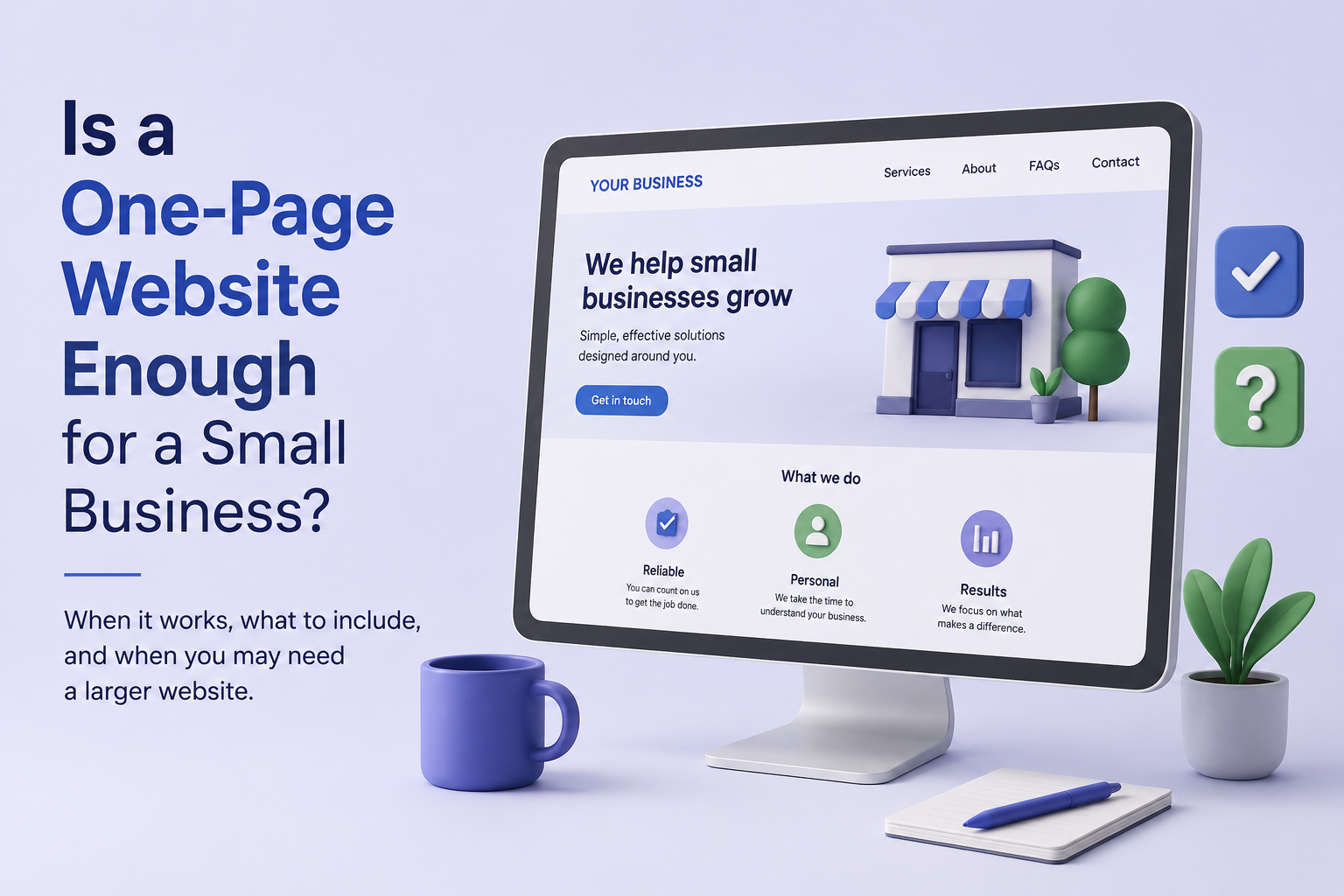
Is a One-Page Website Enough for a Small Business?
For many small businesses, the idea of getting a website can feel bigger than it needs to be.
You may think you need a full website with lots of pages, a blog, advanced features, booking systems, downloads, galleries and complicated navigation. Sometimes that is true. But for many sole traders, start-ups and local service businesses, a clear and professional one-page website can be more than enough to get started properly.
A one-page website gives your business a simple online home. It explains who you are, what you do, who you help and how people can contact you. It does not try to do everything. Instead, it focuses on giving visitors the key information they need in one place.
So, is a one-page website enough for your small business? The answer depends on what you need your website to do.
What does “enough” mean for a small business website?
A website does not need to be large to be useful. It needs to do its job.
For a small business, that job is often quite simple. Your website may need to:
- make your business look credible
- explain what you offer
- show where you work or who you help
- answer common questions
- give people confidence to contact you
- provide a professional link for business cards, social media and directories
If that is what you need, a one-page website can often work very well.
The mistake many business owners make is assuming that more pages automatically means a better website. That is not always true. A larger website with weak content, confusing navigation and unclear messaging will not help your business as much as a focused one-page website that says the right things clearly.
When a one-page website is usually enough
A one-page website is often enough when your business has a clear, simple offer.
For example, you may provide one main service, or a small number of closely related services. You may work in a local area. You may mainly want people to call, email or send an enquiry. You may not need lots of written content, case studies or separate service pages yet.
A one-page website can be a good fit for:
- sole traders
- freelancers
- consultants
- tradespeople
- cleaners
- gardeners
- tutors
- mobile service providers
- therapists and wellbeing businesses
- start-ups testing a new idea
- small businesses currently relying on social media only
If your business is fairly easy to explain, a one-page website can give you everything you need without making the project bigger, slower or more expensive than necessary.
Why a one-page website can work so well
A good one-page website is simple for visitors to use. They do not need to click around lots of different pages. They can scroll through the information in a clear order and quickly decide whether your business is right for them.
This can be especially useful on mobile phones. Many people looking for a small business are searching while busy, distracted or out and about. They may not want to spend ten minutes reading through a complicated website. They want to know what you do, whether you seem trustworthy and how to contact you.
A one-page website helps by keeping the experience focused.
It can also be easier for you as the business owner. You do not have to write pages and pages of content. You do not have to plan a large website structure. You do not have to commit to a major project before you are ready.
Instead, you can get online properly with a professional website that covers the essentials.
What should a one-page website include?
For a one-page website to be enough, it needs to include the right information. It should not just be a short online flyer. It should be structured properly so that visitors understand your business and feel confident taking the next step.
A strong one-page website should usually include the following sections.
1. A clear introduction
The top section of your website needs to say what you do straight away. Visitors should not have to guess.
A good introduction should include your business name, a short explanation of your service, your location or service area if relevant, and a clear call to action.
For example, instead of saying:
“Welcome to our website. We provide high-quality solutions.”
It is much better to say something specific, such as:
“Professional garden maintenance for homes and small businesses in Bedford.”
Clear beats clever.
2. Your services
Your website should explain what you offer in plain English. This does not need to be complicated. A short list of services with simple descriptions is often enough.
The important thing is that visitors can quickly recognise whether you provide what they need.
3. A short about section
People often choose small businesses because they like the person or people behind them. A short about section can help build trust.
You might mention your experience, your approach, why you started the business or what customers can expect when working with you.
4. Proof or reassurance
If you have testimonials, reviews, accreditations, photos of work, examples or relevant experience, include them. These details help visitors feel more confident.
Even one or two strong pieces of proof can make a big difference.
5. Frequently asked questions
FAQs are useful because they remove small doubts before someone contacts you.
You could answer questions about pricing, availability, areas covered, how the process works, what is included or what a customer needs to provide.
6. Contact details
Your contact section should be obvious and easy to use. Include the best way for people to reach you, whether that is a phone number, email address, enquiry form or social media link.
If you want enquiries, make the next step clear.
When a one-page website may not be enough
A one-page website is not right for every business.
You may need a larger website if your business has several distinct services, multiple customer types, different locations, detailed case studies, online booking, ecommerce or a content strategy built around regular articles.
For example, a business offering plumbing, heating, bathrooms, emergency call-outs and commercial contracts may eventually benefit from separate pages for each service. A shop selling products online will need more than a one-page website. A business trying to rank on Google for lots of different towns and services may need a larger SEO structure.
A one-page website can still be a good starting point, but it may not be the final version of the website forever.
Can a one-page website rank on Google?
A one-page website can appear in Google, especially for your business name and focused local searches. However, it has less room to target lots of different keywords than a larger website.
That means the page needs to be focused. It should be clear what the business does, where it operates and who it helps.
For example, a one-page website for a local electrician should include phrases people might naturally search for, such as “electrician in [town]”, “domestic electrical work”, “lighting installation” or “electrical repairs”, where accurate and relevant.
However, it should not try to target too many unrelated topics at once. A one-page website works best when the SEO goal is simple and realistic.
For many small businesses, the first SEO priority is not ranking nationally for a competitive keyword. It is being found when someone searches for the business name, checks credibility after a recommendation or looks for a local provider.
Is a one-page website better than only using Facebook?
For many small businesses, the alternative to a one-page website is not a large website. It is having no website at all.
Many business owners rely on Facebook, Instagram, marketplace profiles, directory listings or word of mouth. Those can all be useful, but they are not the same as having your own website.
A website gives you a professional online home that you control. You can put it on business cards, flyers, email signatures, adverts, Google Business Profile, invoices and social media profiles.
It also helps people who do not use social media, or who want to check your business before getting in touch.
A simple one-page website can make your business feel more established, more trustworthy and easier to contact.
What are the benefits of starting with one page?
Starting with a one-page website can be a sensible business decision.
The main benefits include:
- Lower upfront commitment compared with a larger custom website
- Faster launch because there is less content to prepare
- Clearer message because everything has to be focused
- Less overwhelm for business owners who are not technical
- Easy maintenance when the site is fully managed
- Room to grow if the business needs more pages later
It is not about cutting corners. It is about choosing the right size of website for where your business is now.
Can you upgrade from a one-page website later?
Yes. A one-page website can be the first stage of a larger website.
As your business develops, you may decide to add separate pages for services, locations, case studies, reviews, blog posts or booking features.
This is often a better approach than trying to build a large website before you know exactly what you need. You can start with a focused page, learn what customers ask about, then expand the website based on real business needs.
For many small businesses, that is a more practical route.
So, is a one-page website enough?
A one-page website is enough for many small businesses, especially if you need a clear, professional and affordable way to get online.
It is enough if your main goal is to look credible, explain your services and make it easy for people to contact you.
It may not be enough if you need lots of separate pages, advanced features or a broad SEO strategy from the beginning.
The important thing is to choose the right website for your current stage, rather than assuming bigger is automatically better.
A simple website can still be a professional website
A one-page website should not feel like a temporary placeholder or a cheap compromise. Done properly, it can be a polished, professional and effective online presence.
It can help you move beyond social media only, give customers somewhere credible to visit and make your business easier to recommend.
With 1PW, your one-page website is designed, hosted, managed and supported for you. That means you do not have to deal with the technical side, and you do not need to start with a large upfront website project.
You can start simple, get online properly and grow when the time is right.